


Artificial Analysis is an independent analysis platform that measures the performance of AI models and API/inference providers using public data, not manufacturer advertisements. It tells you which model is faster, cheaper, "smarter" according to standardized evaluations, but it does not automatically turn choosing the right model into a stable content operation process. This article explains clearly what this tool measures, how to use it, and more importantly: its limitations when you need a content operations system, not just a comparison table.
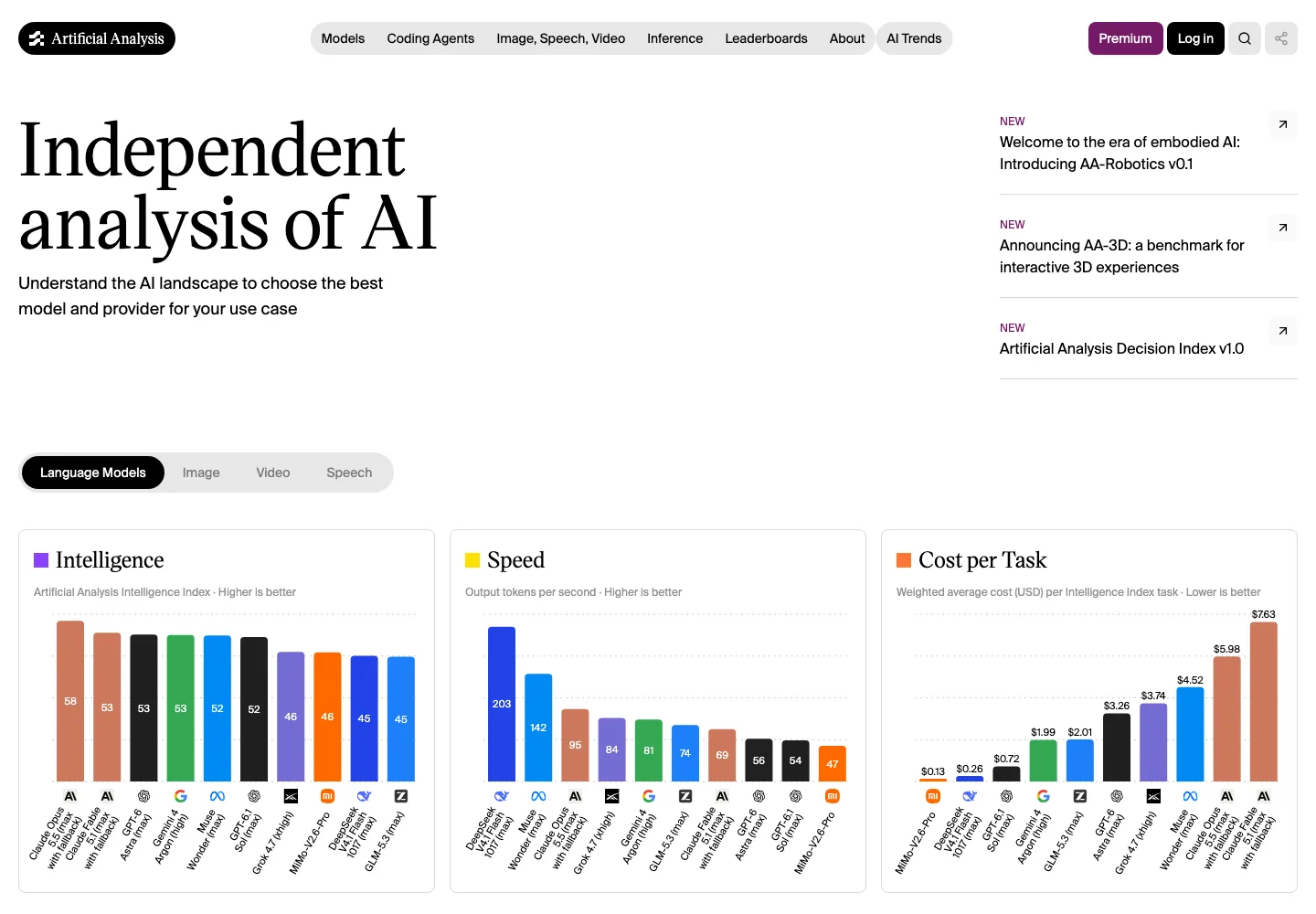
Artificial Analysis homepage: three charts for Intelligence, Speed and Cost per Task for language models; tabs for Image, Video, Speech for image, video, speech models. Screenshot from artificialanalysis.ai, October 2026.
What is Artificial Analysis?
Artificial Analysis is an independent analysis platform for AI models and API/inference providers, allowing users to "understand the AI context to choose models and providers suitable for specific needs" (source: artificialanalysis.ai, accessed October 2026). The measurement scope goes beyond language models to include images, video and speech. If you are considering tools for creating illustrations, text-to-speech for video, or converting text to short video for social media, the website also has comparison data for those groups.
If you have already read the specific tool page about Artificial Analysis on OPCAIOS at Artificial Analysis, this article will go deeper into how to read the data and practical limitations when applying it to content work, without repeating the tool introduction section.
How is Artificial Analysis different from rankings published by manufacturers themselves?
Artificial Analysis is a third party that measures independently, while rankings like "model X tops all benchmarks" on many blogs usually rely on results the model manufacturer itself published. Artificial Analysis data is compiled from many standardized evaluations across many different models and providers, so it is more objective when comparing.
A hypothetical example: a freelancer is choosing between ChatGPT from OpenAI and Claude from Anthropic to write articles for 3 clients. First, you look at independent data according to Artificial Analysis (accessed October 2026) instead of trusting advertisements. Next, you test it yourself on your own tasks, because benchmarks are only a reference and cannot replace real testing. Finally, you decide based on three axes: intelligence, speed and cost.
What metrics does Artificial Analysis measure?
Artificial Analysis measures three main axes for each model: Intelligence (composite smartness index), Speed (output token generation speed per second) and Cost per Task (average cost in USD for a standardized task), according to Artificial Analysis (accessed October 2026). Intelligence Index is a composite index from many sub-evaluations. In version v4.3.2, the index comprises 10 evaluations: AA-Briefcase v1.1, GDPval-AA v2.1, AutomationBench-AA, Terminal-Bench 4.0, SciCode, Humanity's Last Exam, GDP.pdf, CritPt, AA-Omniscience and AA-LCR v1.1. So the intelligence score is not a single test but a result compiled from multiple tests with different difficulty levels, from programming, science to long-form text comprehension. For example, when choosing a model for article writing, first read Intelligence, then cross-reference Speed and Cost per Task in step 2 on the same chart.
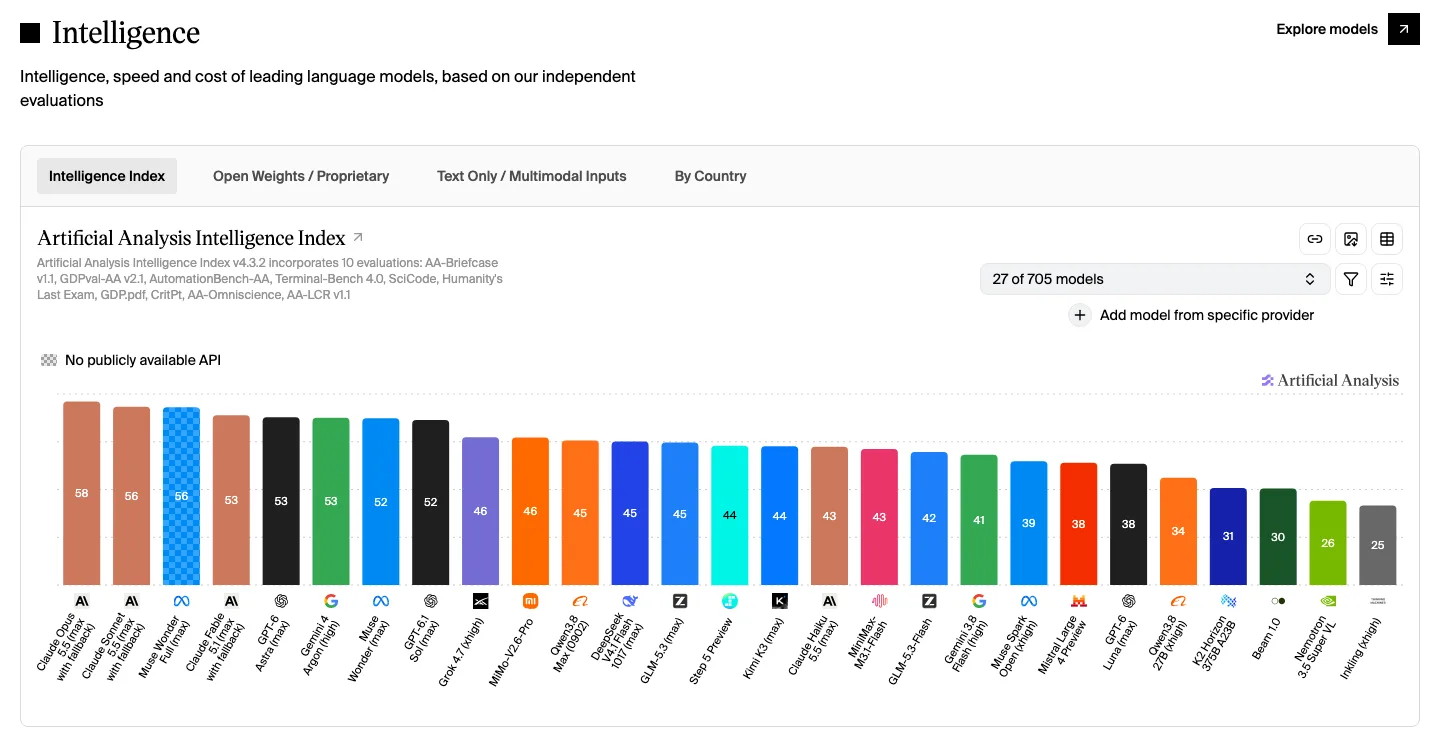
Intelligence Index chart: each column is a model, higher score is better. The description line above lists 10 evaluations compiled into the index. Screenshot from artificialanalysis.ai, October 2026.
What are Model Recommender and Optima used for?
Model Recommender is a feature that suggests models based on your personal priorities between intelligence, speed, and cost. Optima lets you build your own benchmark, which is useful when you want to measure according to specific needs instead of just using available metrics (according to Artificial Analysis, read October 2026).
Here's a hypothetical example: you write articles for real estate clients and need a model that maintains an advisory tone while saving costs (Cost) when running 20-30 articles per month. First, select low-cost priority in Model Recommender to filter quickly, for instance between Claude from Anthropic and ChatGPT from OpenAI. Next, use Optima to build a small benchmark from a few of your sample articles, running each test 3 times. Finally, compare across three axes instead of choosing based on hearsay like "I heard this model is good".
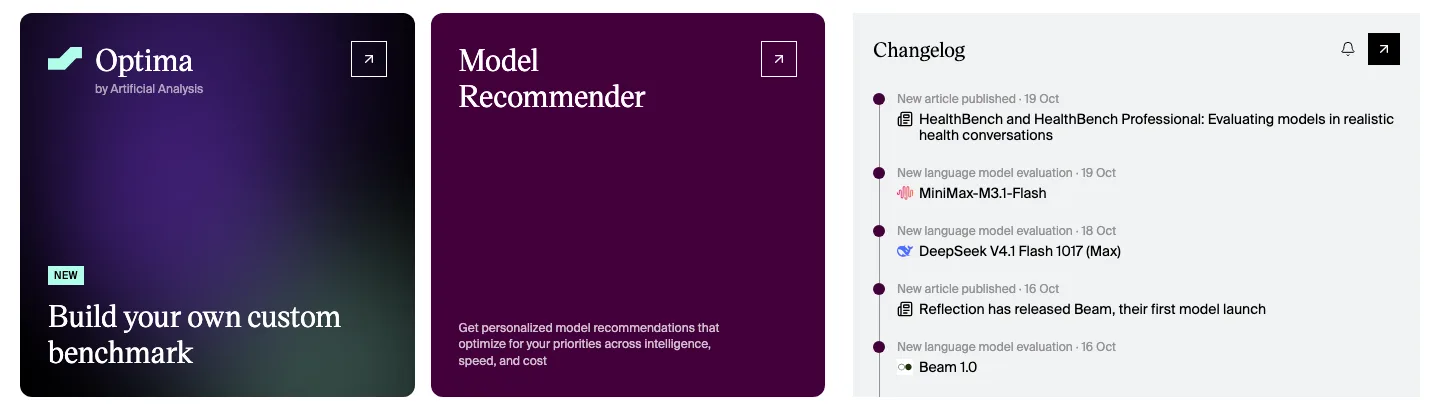
Optima (build your own benchmark) and Model Recommender (suggest models by intelligence, speed, cost priorities). Screenshot from artificialanalysis.ai, October 2026.
What are the differences between Artificial Analysis usage tiers?
Artificial Analysis has two main paid plans, plus public data that doesn't require registration. The table below follows Artificial Analysis's pricing page, read October 2026.
| Plan | Price | For | Includes |
|---|---|---|---|
| Pro | $417/month per seat (discount available for annual payment) | Individuals and small organizations | API access, export data for personal analysis, build custom charts/tables, access industry reports, email support |
| Enterprise | Custom pricing | Organizations 150+ people | All Pro permissions, plus higher API limits, compute market forecasting models, AI strategy consulting, personalized support |
For freelancers or agencies with 1-5 people, the public data (Intelligence, Speed, Cost rankings and Model Recommender) is usually enough to choose a model for routine content work. For example, a 3-person agency only needs Step 1: use public data to select a model. Step 2: only upgrade to Pro $417/month later when you need to export raw data or integrate via API into automated workflows.
How do you read Artificial Analysis data to choose a model suitable for content work?
The right way is to identify your actual task first, then look at Artificial Analysis data (read October 2026), instead of opening the rankings and picking the top model. First is task classification (step 1). For instance, if you write 1,500-word blog articles each week for 3 different clients, your task differs completely from an agency running content pillars in bulk for social media. Before opening the Intelligence Index table, ask yourself: does the task need deep reasoning (write in-depth analysis) or does it need speed and volume (recycle one idea into 10 different formats)?
Next, remember that the highest Intelligence score doesn't mean the best fit. With large volume, such as recycling content to multiple platforms daily, Cost per Task and Speed matter just as much as overall intelligence score. A model ranked 5th in Intelligence but 3 times cheaper and twice as fast might be more practical for repetitive work (this is a hypothetical example to illustrate how to read, not actual measurements).
Why shouldn't you depend on a single model?
OPCAIOS's operational view is that systems should not depend on a single model. Using multiple models for the right job in the right place—for example, one model strong at reasoning for the research and insight part and one model fast and cheap for format recycling—is safer than being entirely tied to one provider, which can change pricing or policy anytime.
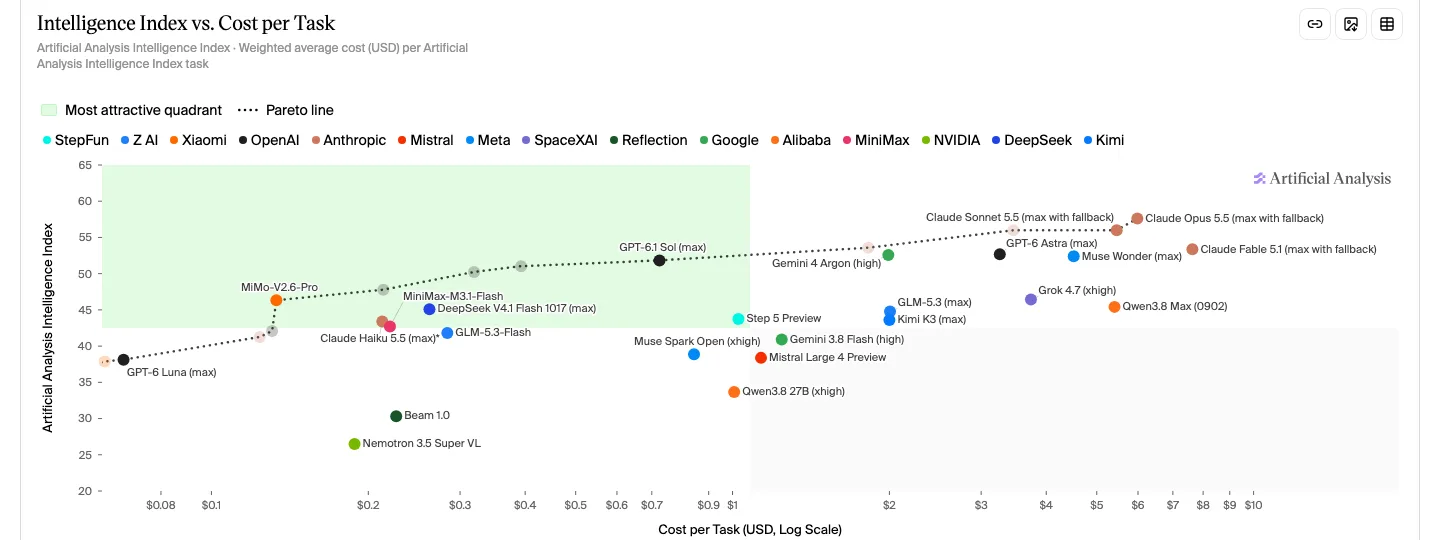
Intelligence Index versus cost per task (horizontal axis in log form). The green area is the group of models that are both intelligent and cheap; the dotted line shows optimal choices at each price point. Screenshot from artificialanalysis.ai, October 2026.
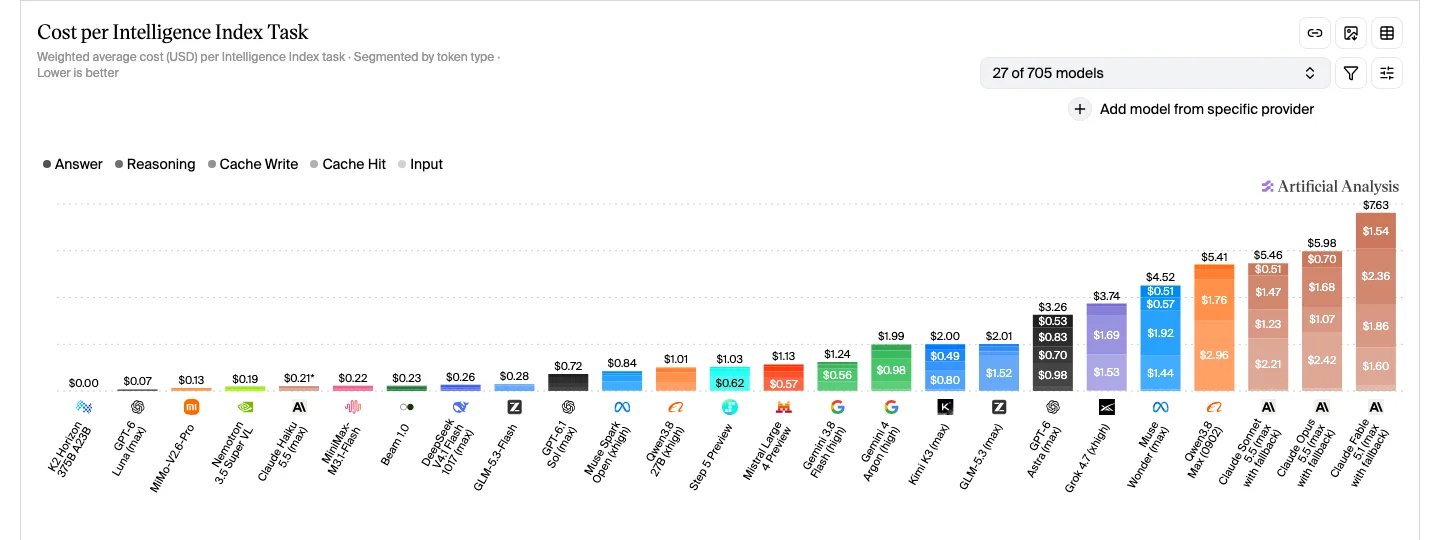
Cost per task divided by token type (output, reasoning, cache, input): with many models, the reasoning part takes up a significant portion of cost. Screenshot from artificialanalysis.ai, October 2026.
Why Choosing the Right Model is Only a Necessary Condition, Not a Sufficient One?
Artificial Analysis solves the problem of "which model is best for task X" using independent data, and that's its real value. But it doesn't solve another, bigger problem: how do I produce a steady volume of content, in the right expert voice, with someone reviewing it before publishing.
This is where many freelancers and small agency owners get stuck. They spend hours comparing models, switching from one tool to another because they heard a newly released model is better, but each time they sit down to write, they still start from a blank page. The problem isn't the model, it's that they don't have context and processes saved for reuse.
Using multiple AIs doesn't mean having an AI system. A freelancer might be running ChatGPT, Claude, and an image generation tool at the same time, but if each time they work they have to explain the customer context, writing voice, and article goal all over again from scratch, then those are still three separate tools, not a system. A prompt isn't an asset; it disappears after each use. Context and process are assets, because they're saved, reused, and improved over time.
This is also why someone creating content alone still needs to think about an operating model, not just individual tools—something that AI Automation System Building focuses on solving: turning scattered AI tools into a workflow with saved context, with someone reviewing before publishing.
Checklist Before Choosing Your Next AI Tool
Before you spend more time comparing new models, answer these three questions for yourself:
- How many times a week does this task repeat? If it repeats often (for example, writing 10 articles a week in the same structure), the problem is usually a missing process, not a need for a better model. Switching models doesn't solve the fact that you still have to re-enter context each time.
- Does the new model keep your expert voice and customer context, or is it just faster and cheaper? A 30% cheaper model that produces generic content and loses your writing voice might cost you more time in revisions than you save.
- After publishing content, do you have a way to measure which content actually signals real customer interest? If your answer is no, then you're switching tools constantly without measuring what matters most: whether content actually brings you business opportunities.
If all three of these questions make you realize the problem is in your process, not your tools, that's a sign to rethink how you organize your work before trying another new model.
Artificial Analysis is a Reference Tool, Not an Operating System
Using Artificial Analysis to choose a model is a right step, but a small one, in a bigger problem: turning scattered AI into a stable system for creating content and customer signals. It gives you independent data to pick the right tool; it doesn't give you a process to make that tool work consistently, in the right voice, and with real impact measured.
If you want to see how an AI system actually works in practice, not just a model comparison table, you can follow Case Study #0, which is being measured directly on Le Quoc Nghia at OPCAIOS. Numbers will be published when measurement is complete, not predicted figures beforehand. This also reflects our viewpoint clearly: a system doesn't depend on one AI model, and a human always reviews before publishing.
If you're overwhelmed by scattered AI tools, using multiple models but still starting each piece from a blank page, you might sign up for an AI Content Leverage Audit at opcaios.org to see whether your problem is in the tools or in your process. If you need a roadmap to learn how to use AI correctly for your small team, check out AI Application Training.
Frequently Asked Questions
Is Artificial Analysis free?
The public data on the site—Intelligence rankings, Speed, Cost per Task and the Model Recommender feature—don't require payment to view. The Pro plan at $417/month per seat is only needed if you want to use the API, export raw data, or access in-depth industry reports (source: artificialanalysis.ai).
How is Artificial Analysis different from rankings published by model makers themselves?
Artificial Analysis is a third-party making independent measurements, not model makers scoring themselves. The data is compiled from multiple standardized evaluations across different models and providers, making it more objective for comparison.
What is the Intelligence Index?
The Intelligence Index is a composite score from multiple sub-evaluations, not a single test. In version v4.3.2, it combines 10 different evaluations like Humanity's Last Exam, SciCode, Terminal-Bench 4.0 and some others, reflecting model capability across many task types (source: artificialanalysis.ai).
Should I choose a model based only on the highest Intelligence score?
No. A high Intelligence score doesn't mean it's the best fit for your specific task. If you're processing large volumes of content, you should also compare Cost per Task and Speed—a model with a lower intelligence score but significantly cheaper and faster might be more practical for repetitive work.
Is choosing the right model on Artificial Analysis enough to solve content overload?
Not enough. Choosing the right model solves the question of "which tool is best for what," but it doesn't solve the fact that you still start each piece from a blank page if you lack saved context and processes to reuse. This is why you need to look at the problem at the operating system level, not just the tool level.
Translated from Vietnamese with AI. Read the original.
Want to apply this in your business?
Book a free 30-minute call (Vietnam time, in English or Vietnamese).