



There is no best AI model for everything: each model is strong in one group of tasks, and the real cost of a model must be calculated per task completed, not per token. The right way to choose is to define your work, test 2–3 models on your own data, then compare the cost for each usable result. This piece explains how to read ranking tables correctly, a table of suggestions by task group, and the process of quick testing in an afternoon. According to the summary "The 2026 AI Model Showdown" by @kinderlayer (13/10/2026), the same model like Opus 5.5 or Haiku 5.5 can cost $0.07 or $0.61 per attempt depending on effort level. That example shows why you must measure on real work. First identify your task, next test a few models, finally calculate the cost for each usable result.
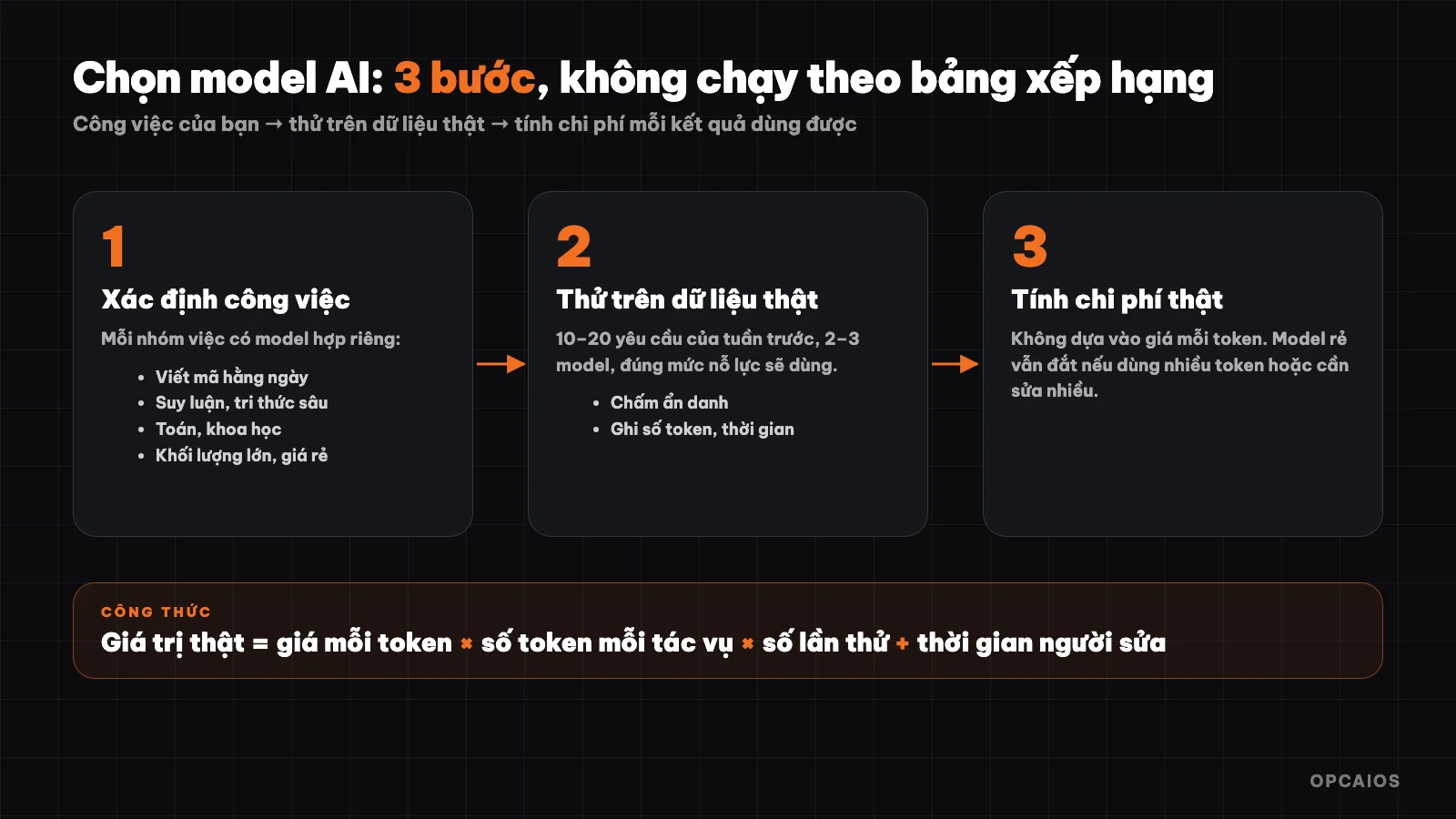
Three steps for choosing an AI model instead of following ranking tables. Diagram: OPCAIOS.
Why is there no best AI model for everything?
The best AI model for everything does not exist because each company optimizes for a different set of benchmarks, and the benchmarks measure different abilities: writing code, scientific reasoning, working with software on screen, or handling large volume at low cost. A model at the top of one table usually sits in the middle of another.
According to the summary by @kinderlayer (13/10/2026), in the coding group, the top three models differ by only a few percentage points and rankings shift depending on who runs the test and at what effort level. In reasoning and professional knowledge work, one model leads clearly; in math and science, another leads. This data comes from many sources, and OPCAIOS has not verified it independently, but the principle holds at all times: an article claiming one model "beats everything" usually rests on one video, one test, or one lucky run.
So the question should shift from "which model is strongest?" to "which model suits this task best, at the price I can afford?".
How do I read benchmark ranking tables correctly?
Benchmark is a standardized test used to compare abilities between models, and the score of the same model can vary widely depending on how it is run. According to @kinderlayer's summary (13/10/2026), there are three factors that change the score but are rarely spelled out in ranking tables.
- Effort level. Most published scores are at maximum effort. For example, Haiku 5.5 reaches 72.4% on the OSWorld computer use test at maximum effort but only 42.0% at low effort, while the cost per attempt rises from $0.07 to $0.61.
- How the score is calculated. That 72.4% figure is from an offline subset with partial scoring; the strict pass rate is only 37.1%.
- Who runs the test. An analysis by Vellum, cited in articles, found the same Claude model diverge by up to 5.4 points between different test runners.
Scores published at launch are usually the table from the manufacturer themselves, run under conditions they choose. Treat all numbers as trends, not conclusions. The only decisive test is your own work volume.
How does cost per task differ from cost per token?
Cost per task is the total real money for a model to complete one job, equal to the price per token times the number of tokens the model uses for that job. A model with cheap per-token cost can still be more expensive if the model "thinks" in more tokens.
An example from @kinderlayer citing Artificial Analysis: Opus 5.5 has a lower price per token than GPT-6 Astra, but at maximum effort Opus writes around 119 thousand tokens per task compared to around 27 thousand for Astra. As a result each task for Opus costs around $5.98 versus $3.26, and running the full benchmark costs around $8,708 versus $5,324. When you lower Opus to medium effort level, the gap narrows sharply, meaning the effort level adjustment dial is also part of the price.
A lesson to apply right now: before comparing price tables, measure the tokens the model uses on real work. Most providers, including OpenAI and Anthropic, return the tokens used in each API response, enough to calculate the cost for each run.
Which work groups suit which model types?
The table below suggests how to match work groups with model types, based on a synthesis by @kinderlayer in October 2026. The figures change quickly, so consider this a starting point to test, not a final conclusion.
| Work group | Selection direction | Main reason |
|---|---|---|
| Daily coding | Mid-tier or high-tier models, nearly equal | Quality differences fall within error margins, price differences are large |
| Reasoning, specialized knowledge work | Leading reasoning models | The largest score gap appears in this group |
| Math, science, abstract problems | Science-strong models | Cheaper models fall notably short in this group |
| Filtering, classification, extraction, bulk drafting tasks | Small cheap models | Most real-world work doesn't need leading models |
| Software operation agents | Try both, compare cost per task | Quality is equivalent, price difference varies |
General principle: use small models for 90% of simple work, move up to mid-tier models when work gets harder, and call leading models only for decisions that need judgment. Popular assistants like ChatGPT, Claude and Gemini all have multiple model tiers, so you can still choose by price within the same provider.
How do I test models on my own work in one afternoon?
Testing models on real work means running the same set of requests through 2–3 models then comparing results and costs, rather than trusting someone else's ranking. The five-step process below needs no programming knowledge, and with a set of 10 requests you usually finish in a few hours.
- Pick 10–20 real requests from last week's work, including both easy and hard ones, such as draft articles for clients, reply emails, or data tables that need summarizing.
- Run the same set of requests through 2–3 models, for example ChatGPT from OpenAI, Claude from Anthropic, and Gemini from Google, at the exact effort level you'd use in practice.
- Score anonymously: shuffle model names then score each result on a simple scale (usable right away, needs light editing, must redo).
- Record token count and time for each run, then calculate cost for each usable result.
- Add human editing time: a cheap model that needs lots of editing might cost more than an expensive model that works right away.
Simplified formula: real value = price per token × tokens per task × number of attempts + human editing time. To look up independent data for choosing candidates, see the post What is Artificial Analysis.
When should I use multiple models instead of one?
Using multiple models is a way to distribute work by difficulty: cheap models do most of it, expensive models only show up where judgment is needed. This approach also reduces the risk of depending on one provider, since price and policy can change anytime in 2026 and beyond.
A typical tiered model found in many automation workflows has three layers:
- First layer uses small models to filter, classify and extract.
- Middle layer uses mid-tier models to draft and handle medium-hard work.
- Last layer uses leading models for review or decision-making.
For example, according to data @kinderlayer cited from Artificial Analysis, one task costs about $5.98 on this model and $3.26 on that one, so repeating it thousands of times creates a meaningful difference. If you build your workflow in n8n or Claude Code, switching models at each step is just changing a parameter. Note: set a common check for outputs, because each model has different habits, and test again when the provider releases a new version.
Frequently Asked Questions
Which AI model is the strongest right now?
There is no strongest model for everything. According to @kinderlayer's summary, each group of tasks has its own leading model: deep reasoning, math and science, everyday coding, or handling large volumes cheaply. Choose based on your task group.
Does a more expensive model always give better results?
No. With many simple tasks like classification or extraction, a smaller model gives nearly equivalent results at much lower cost. Expensive models are worth the money for work requiring deep reasoning or judgment.
Which benchmark ranking should I rely on?
Use independent ranking tables to pick candidates, then test them yourself on real work. Scores in tables change based on effort level, scoring method, and who runs the test, so don't use them to replace your own testing.
How do I calculate the real cost when using an AI model's API?
The real cost when using an API is the total money to get one usable result, which includes token price, number of tries, and time spent fixing results. First, multiply the price per token by the number of tokens the model uses for each task; this token count usually comes in the response from OpenAI, Anthropic, or Google. Next, multiply by the number of tries. Finally, add the time spent fixing results. For example, according to @kinderlayer's post, one task costs around $5.98 with one model and around $3.26 with another, even though the more expensive model has a lower per-token price, because they use different numbers of tokens. See more in the post What is API if you are new to this.
How often should I test again when there is a new model?
You should test again whenever your current provider releases a new version or changes prices, or roughly every quarter if there are no changes. The reason is that the October 2026 ranking might differ from the next month, and a comparison from three months ago was testing a different model from the one you are using today. Keep a set of 10–20 sample requests and the scoring table from last time, for example in a spreadsheet, then retesting only takes a few hours. If you want to build an AI-using process for a small team, see the AI application training course.
Source: data and model names from @kinderlayer's summary post "The 2026 AI Model Showdown" on X (13/10/2026), citing Artificial Analysis, Vellum, and others; OPCAIOS has not done independent verification. The testing steps are OPCAIOS's guidance.
Translated from Vietnamese with AI. Read the original.
Want to apply this in your business?
Book a free 30-minute call (Vietnam time, in English or Vietnamese).