


What is Oh My Pi?
Oh My Pi (the omp command) is an open source coding agent that runs in the terminal: you give it tasks in natural language, the agent reads code, edits files, runs commands and checks the results like a programmer. Unlike Anthropic's Claude Code or OpenAI's Codex, Oh My Pi is not tied to any single AI company. According to the official README (read in October 2026), you choose from over 60 providers, including models that run right on your own machine. The project is released under the MIT license and has over 35,000 stars on GitHub.
This post answers four questions. First, how Oh My Pi differs from Claude Code and Cursor. Second, which models it works with. Third, how to install it. Finally, who should use it and who shouldn't yet. For example, if you're paying for an expensive plan, you might try Oh My Pi with a cheaper model for small tasks.

Oh My Pi (omp): coding agent running in the terminal. Image: Official project README.
What is Oh My Pi?
Oh My Pi is a command-line coding agent, released under the MIT license, developed by Stencil Labs based on Pi, a minimal agent by Mario Zechner. The development team kept Pi's "terminal first" approach and added everything a programmer needs, with the motto "coding agent with IDE built in."
Instead of just reading and editing files as text, Oh My Pi uses the same tools that code editors use: language servers (LSP) for renaming and symbol lookup, real debuggers to pause the program at errors. The current toolset, according to the GitHub README (read October 2026), includes 31 built-in tools, 14 LSP operations and 28 debugger operations. For example, when renaming a function, the agent goes through LSP instead of doing a text search and replace. The project is continuously updated and has over 35,000 stars on GitHub (figures from October 2026).
See summary information and installation instructions on the Oh My Pi page in the Tools library.
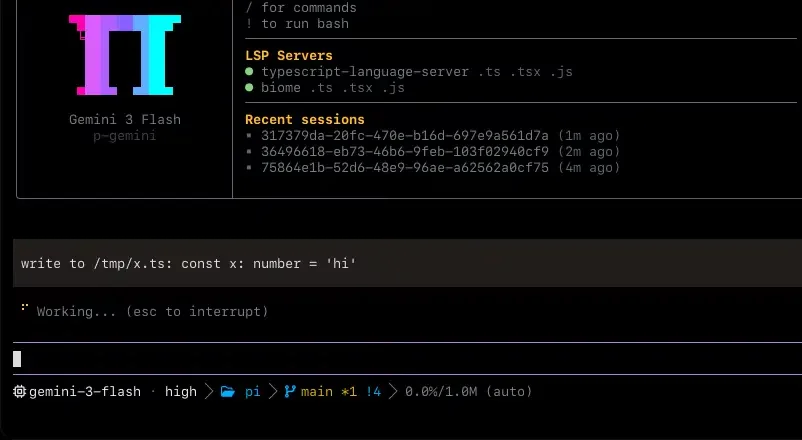
The omp startup screen: model in use (Gemini 3 Flash), connected language servers and recent work sessions. Image: Official README.
How is Oh My Pi different from Claude Code and Cursor?
The biggest difference is the choice of models (as of October 2026). Claude Code uses Anthropic's models; Cursor is an editor with a GUI, billed by subscription. Oh My Pi is free software, runs in the terminal, and you pay the model provider directly for the model you choose, or pay nothing if you run a model on your machine.
| Criterion | Oh My Pi | Claude Code | Cursor |
|---|---|---|---|
| Type | Command line (terminal), with Zed integration | Command line, has IDE and web versions | Code editor with GUI |
| Source code | Open (MIT) | No | No |
| AI model | Over 60 providers, subscription plans, models run on machine | Anthropic's models | Multiple models via Cursor subscriptions |
| Software cost | Free | Requires paid Claude plan or API | Has free plan and paid plans |
| Best for | People comfortable with terminal, want control over model choice | Claude ecosystem users | People who prefer visual interface |
First, if you're just starting out and not comfortable with the command line yet, Cursor is still easier to pick up. Second, Oh My Pi is worth trying if you've already used a coding agent and want to cut costs or not depend on a single company. For example, someone who used Claude Code for 2 months could try Oh My Pi for small tasks.
Which AI models work with Oh My Pi?
Oh My Pi works with more than 60 providers, which means you choose models based on price and quality rather than by vendor. According to the official README (read in October 2026), model sources are divided into four groups:
- Direct APIs and gateways: Anthropic, OpenAI, Google Gemini, Google Vertex, xAI, DeepSeek, Mistral, Groq, Amazon Bedrock, Azure OpenAI, OpenRouter, Hugging Face and many other providers.
- Programming subscription packages: sign in with
/loginusing GitHub Copilot, Cursor, GitLab Duo, Kimi Code, GLM Coding Plan… - Run locally: Ollama, LM Studio, llama.cpp, vLLM, no API key needed.
- Custom endpoints: any service following the OpenAI standard, declared in the
~/.omp/agent/models.ymlfile.
Finally, each session has multiple model "roles": default for routine work, smol for subagents that need to be cheap, slow for work that needs deep thinking, plan for planning mode. This way you can have cheap models do most of the work and only call expensive models when you really need to. Oh My Pi also supports fallback chains: when the main provider hits its rate limit, the session automatically switches to the next model.
Which features are most worth noting?
The seven features below make the clearest difference compared to an ordinary code-writing chatbot.
Hashline, code edits by "fingerprint". Instead of retyping the entire code section you want to change, the model just points to it using a content hash. This avoids the familiar error loop of "string not found", and if the file was modified in the meantime, the old edit is rejected before it can break the code.
LSP attached to every edit. When you ask to rename a function or move a file, Oh My Pi goes through the language server so import statements and file exports are updated at the same time, like a rename operation in an editor.
Real debugger. The agent can attach lldb to a C program with memory errors, dlv to a hanging Go service, or debugpy to a Python process, then stop at the exact error location and read variable values.
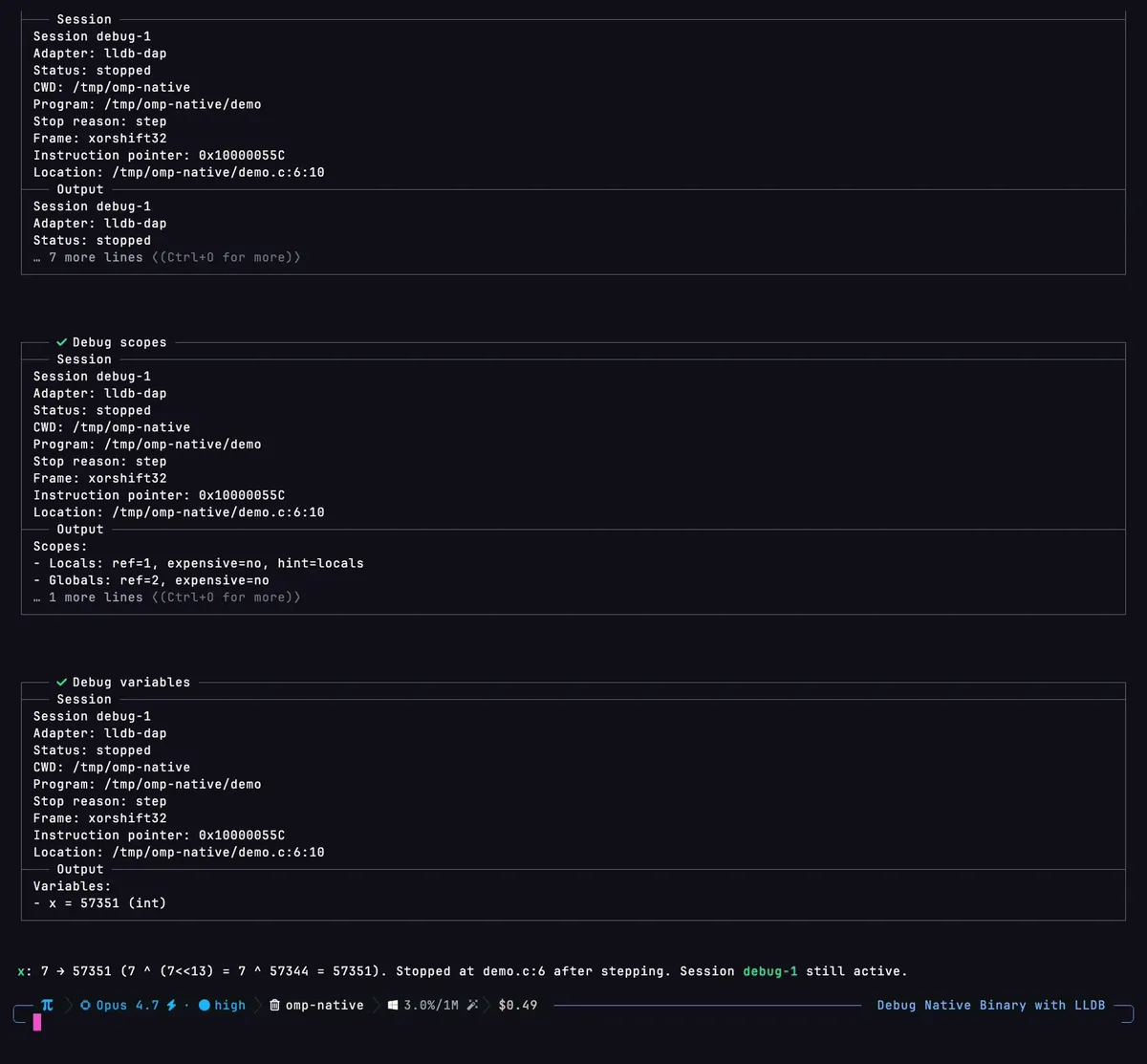
omp attaches lldb to a C program, stops at the function causing the error and reads variable values. Image: omp.sh.
Subagents running in parallel. The task tool divides a big job among multiple child agents, each agent can run in its own copy of the project (worktree) so they don't step on each other. Press Alt+A to open Agent Hub to see what each agent is doing.
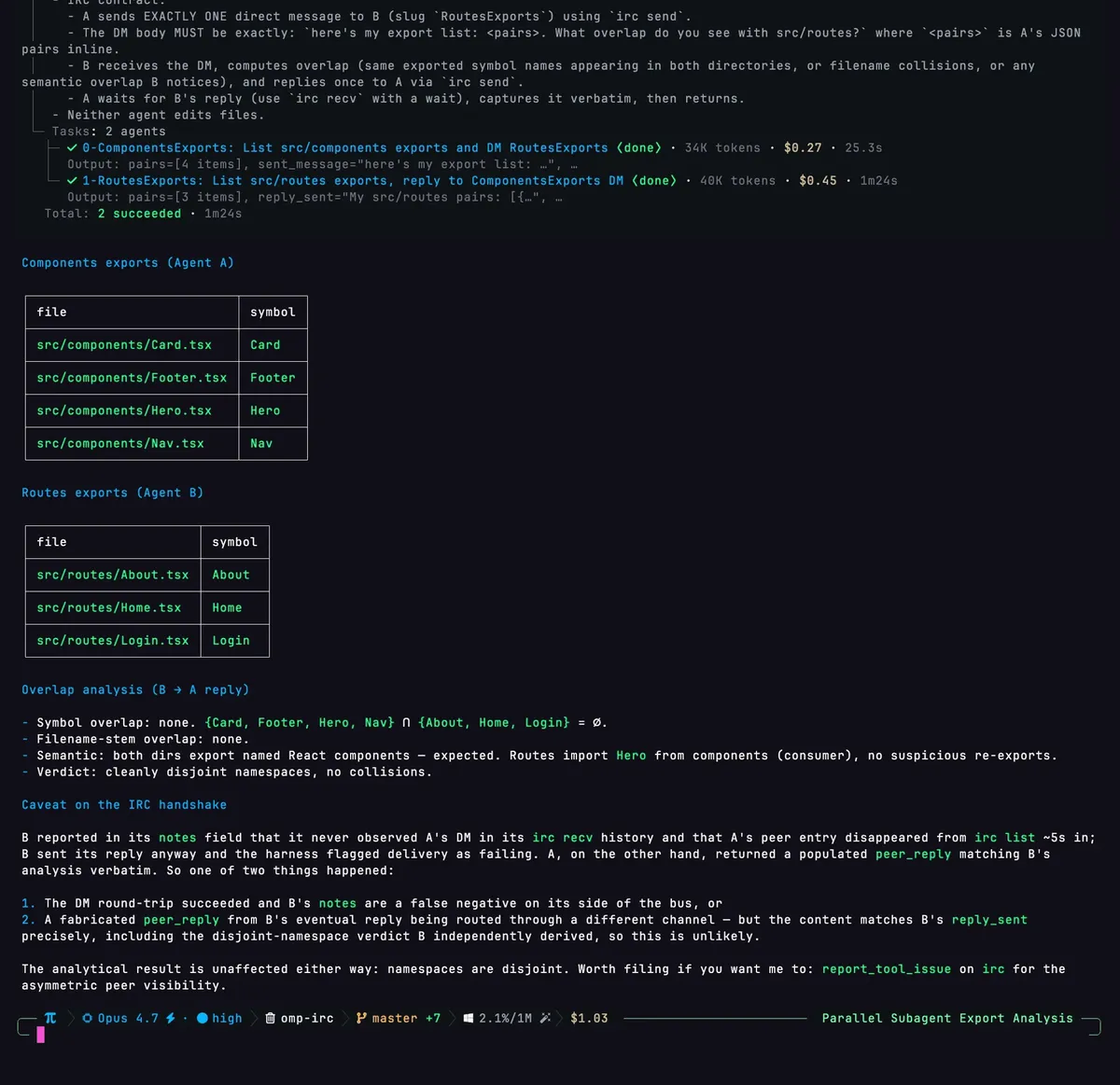
Two subagents running in parallel, each agent shows token count, cost and time; results are merged into a table. Image: omp.sh.
Browser, web search and GitHub built in. The agent controls Chromium or a Chrome tab you have open, searches across 23 sources, and reads pull requests or issues on GitHub like reading a file.
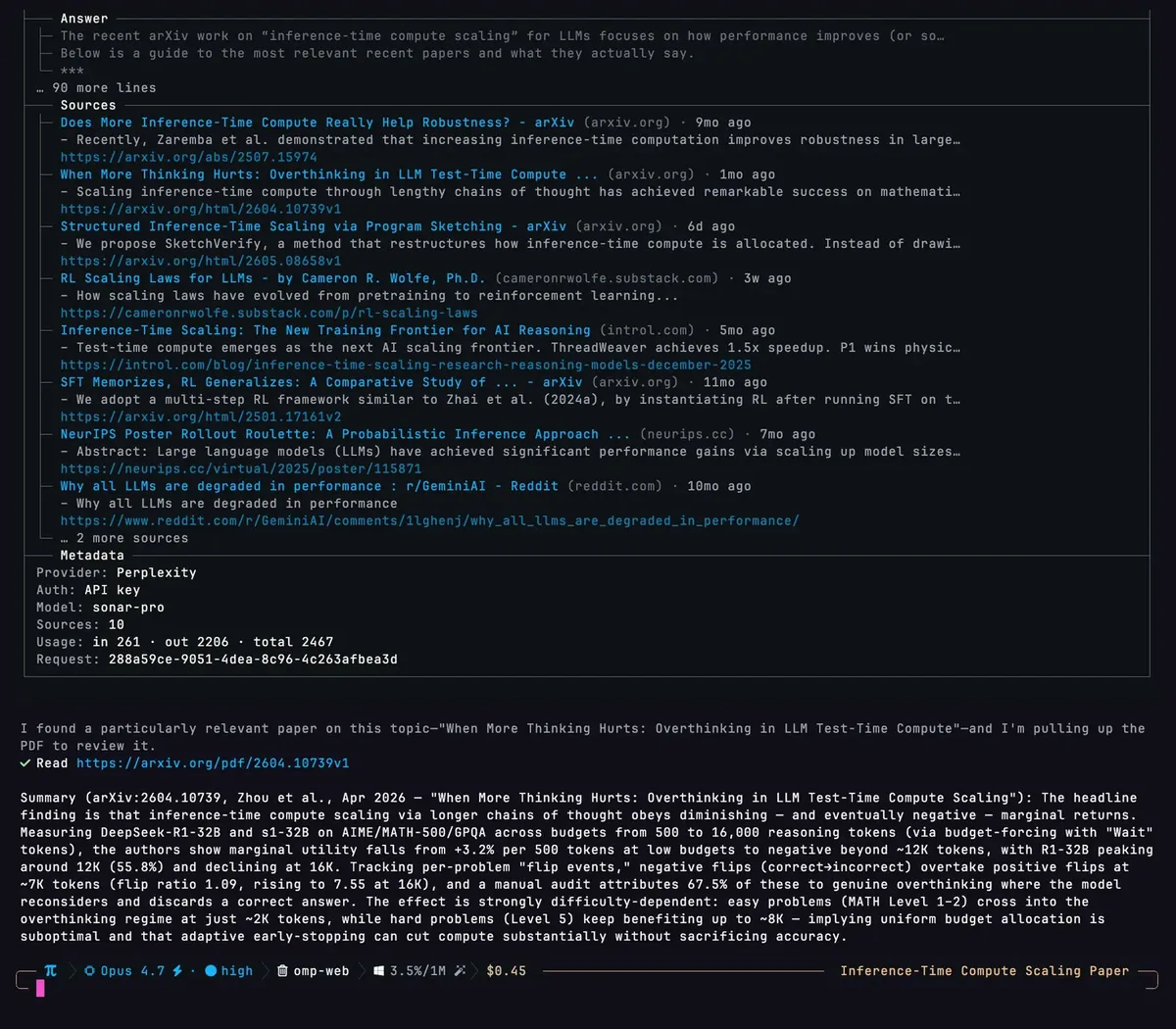
The web_search tool returns ranked sources, the agent opens a PDF paper on arXiv and summarizes the main results. Image: omp.sh.
Review and structured commits. The /review command gives a conclusion whether changes should be pushed or not, with each issue ranked from P0 to P3. The omp commit command splits unrelated changes into multiple small commits in the correct dependency order.
Memory and session sharing. The agent records knowledge about the project to use in later sessions (this feature is off by default, turn it on in settings). The /collab command creates a link or QR code for others to view or jointly control the running session.
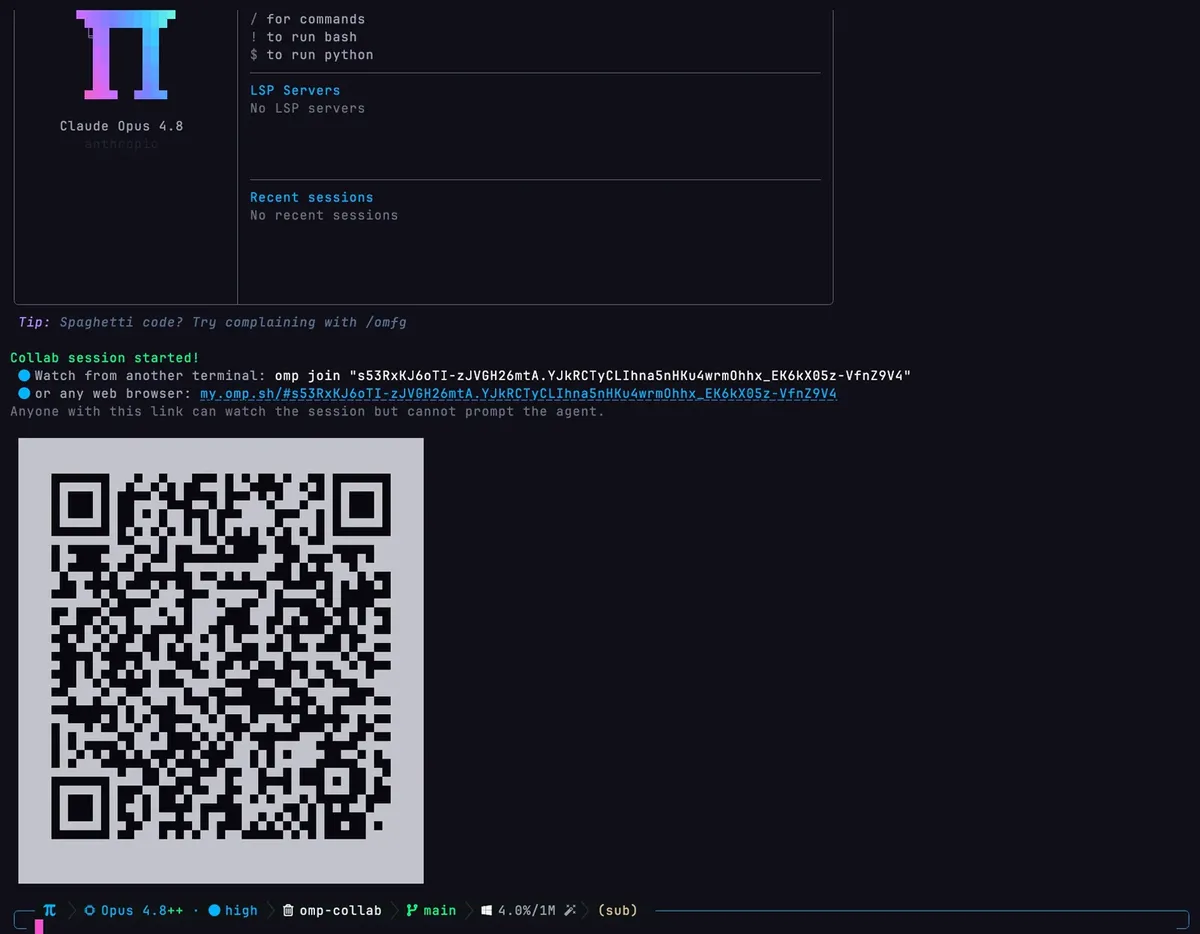
/collab view creates a view-only link and QR code: others can follow the session but cannot give orders to the agent. Image: omp.sh.
One convenience for people who've used other tools: Oh My Pi reads existing rule files like AGENTS.md, Cursor rules or .clinerules, so you don't have to rewrite your configuration.
How to Install Oh My Pi?
Oh My Pi runs on macOS, Linux and Windows with the same build, no WSL needed. Install with one command:
- macOS / Linux:
curl -fsSL https://omp.sh/install | sh - Windows (PowerShell):
irm https://omp.sh/install.ps1 | iex - Homebrew:
brew install can1357/tap/omp
After installing, run omp setup to choose a default model, then open terminal in your project folder and type omp. Assign work using plain language, for example: "Read this project and summarize the architecture, list 3 places most prone to bugs." Switch models mid-session using /model.
Can I use Oh My Pi with cheap models or run it on my own machine?
Yes, and that's why many people choose Oh My Pi. With models running locally via Ollama or LM Studio, you don't need an API key and you don't spend money on model calls. In return, quality depends on the model and your machine's setup. According to the official README (read October 2026), Oh My Pi supports Ollama, LM Studio, llama.cpp and vLLM, so you have 4 options to run locally without an API key.
If you're using a gateway that aggregates multiple models following the OpenAI standard (like 9Router, LiteLLM or your own vLLM server), just declare it in ~/.omp/agent/models.yml:
providers:
  my-gateway:
    baseUrl: http://127.0.0.1:20128/v1
    api: openai-completions
    apiKey: <your key>
    models:
      - id: model-name
        name: My Model
Check it with omp models my-gateway, then select that model in omp setup or /model. A sensible way for a solo worker to use it, example scenario: step 1, set a cheap model for the smol role (subagent). Step 2, set a powerful model for the slow role. Finally, test a small task in 30 minutes to see if quality is good enough, then expand.
Are there Oh My Pi reviews and tutorials I should watch?
If you want to see Oh My Pi running for real before installing, here are 4 YouTube videos (English, you can turn on auto-translate captions). These are the video creators' perspectives, not OPCAIOS reviews.
1. Full test and comparison with Claude Code, channel AI Stack Engineer, "This Free Terminal Agent Made Me Delete Claude Code (Oh-My-Pi Full Test)".
2. Learn all of Oh My Pi in 56 minutes, channel Superposition, "Learn the Entire Oh My Pi in 56 Minutes". Good when you've already installed and want to go through all features.
3. Quick overview, channel Fluid Coding & AI, "Oh My Pi (omp.sh): The Terminal Agent With the IDE Wired In".
4. Subagents, RPC mode and precise code fixing, channel Alex Hitt, "Oh My Pi GitHub Tutorial: Subagents, RPC Mode, and Deterministic Code Patching".
Oh My Pi updates very fast, so the interface and commands in videos may differ from your installed version; when there's a difference, trust the official documentation.
Who should use Oh My Pi, and who shouldn't yet?
Oh My Pi suits people comfortable with the terminal and able to read code: freelance developers, technical staff at small businesses, people using Claude Code or Codex who want to choose models themselves to cut costs.
You shouldn't start with Oh My Pi if you've never used command line, can't read code, or need a visual interface to see changes. Then an AI-powered editor like Cursor will be easier; once you're familiar with working with a coding agent, you can move to Oh My Pi.
If your business wants to bring coding agents or AI into your workflow but doesn't know where to start, OPCAIOS has AI application training programs and AI Automation system building services tailored to your real needs.
Read more: What is Orca? Run multiple coding agents in parallel, each agent in its own git worktree; Coding agents for people who don't know how to code, safe workflow.
Frequently Asked Questions
Is Oh My Pi free?
Yes. Oh My Pi is open source software under the MIT license and costs nothing, according to the README on GitHub (as read in October 2026). The only expense is the cost of calling the AI model from the provider you choose, such as the API from Anthropic, OpenAI, or Google. If you use a model running on your machine through Ollama or LM Studio, you won't have this cost, but the quality depends on the model and your machine's configuration.
Example scenario: you try Oh My Pi for 2 hours with a cheap model for writing tests. First, the software cost is $0. Then, you only pay for the tokens you used with your provider. Finally, you compare it with your current package bill and decide. Token prices vary by company and change frequently, so check the official pricing page before calculating.
Does Oh My Pi support MCP?
Yes. Oh My Pi automatically finds MCP servers declared in the configuration of other tools and in your project's .mcp.json file. If you don't want to load MCP configuration from your project, you can disable it with the mcp.enableProjectConfig setting.
Does Oh My Pi run on Windows?
Yes. The same Oh My Pi build runs on macOS, Linux, and Windows (both x64 and ARM machines) without needing WSL. On Windows, install it with the PowerShell command irm https://omp.sh/install.ps1 | iex.
How are Oh My Pi and Pi different?
Mario Zechner's Pi is a minimal coding agent that runs in the terminal. Oh My Pi is developed from Pi, keeping that approach but with many built-in tools added: LSP, debugger, subagent, browser, web search, code review, memory, and session sharing.
Is it safe to use Oh My Pi with company code?
Your code is sent to the model provider you choose, so privacy depends on that provider's policy. If you need to keep your code completely internal, use a model running on your machine or on a private server; always review changes before committing.
Conclusion
Oh My Pi is worth considering if you want a powerful coding agent without being locked into one AI company: it's free, open source, works with cheap models or models on your machine, and comes with IDE-like tools such as LSP and debugger. In return, it requires you to be comfortable with the terminal and able to read code.
Getting started: install with one command at omp.sh, run omp setup, pick a cheap model, and try giving it a small task in your project, such as summarizing the architecture or writing a test for a function.
This article is based on Oh My Pi's official documentation (README on GitHub, omp.sh) as of October 2026; features and the provider list may change with updates. Illustration images are from the project's README and omp.sh; videos belong to the YouTube channels credited.
Translated from Vietnamese with AI. Read the original.
Want to apply this in your business?
Book a free 30-minute call (Vietnam time, in English or Vietnamese).