



Claude Sonnet 5.5 is Anthropic's AI model launched on September 28, 2026, the second model in the Claude 5.5 family after Opus 5.5. The API price is $2 per million input tokens and $10 per million output tokens, exactly half that of Opus 5.5, while running 30% faster than Sonnet 5 and costing up to 30% less per task. According to Anthropic, Sonnet 5.5 excels at clear daily-use cases, bug fixing, and creating polished documents, slides, and spreadsheets; complex, open-ended work requiring sustained judgment still belongs to Opus 5.5. According to Anthropic's model page, Sonnet 5.5 has a 1 million token context window, maximum output of 128,000 tokens, and runs on Claude Platform, Amazon Bedrock, Google Cloud, and Microsoft Foundry. For example, a task with 100,000 input tokens and 20,000 output tokens costs roughly $0.40 with Sonnet 5.5, compared to $0.80 with Opus 5.5 for the same token count (illustrative calculation, see pricing section below).
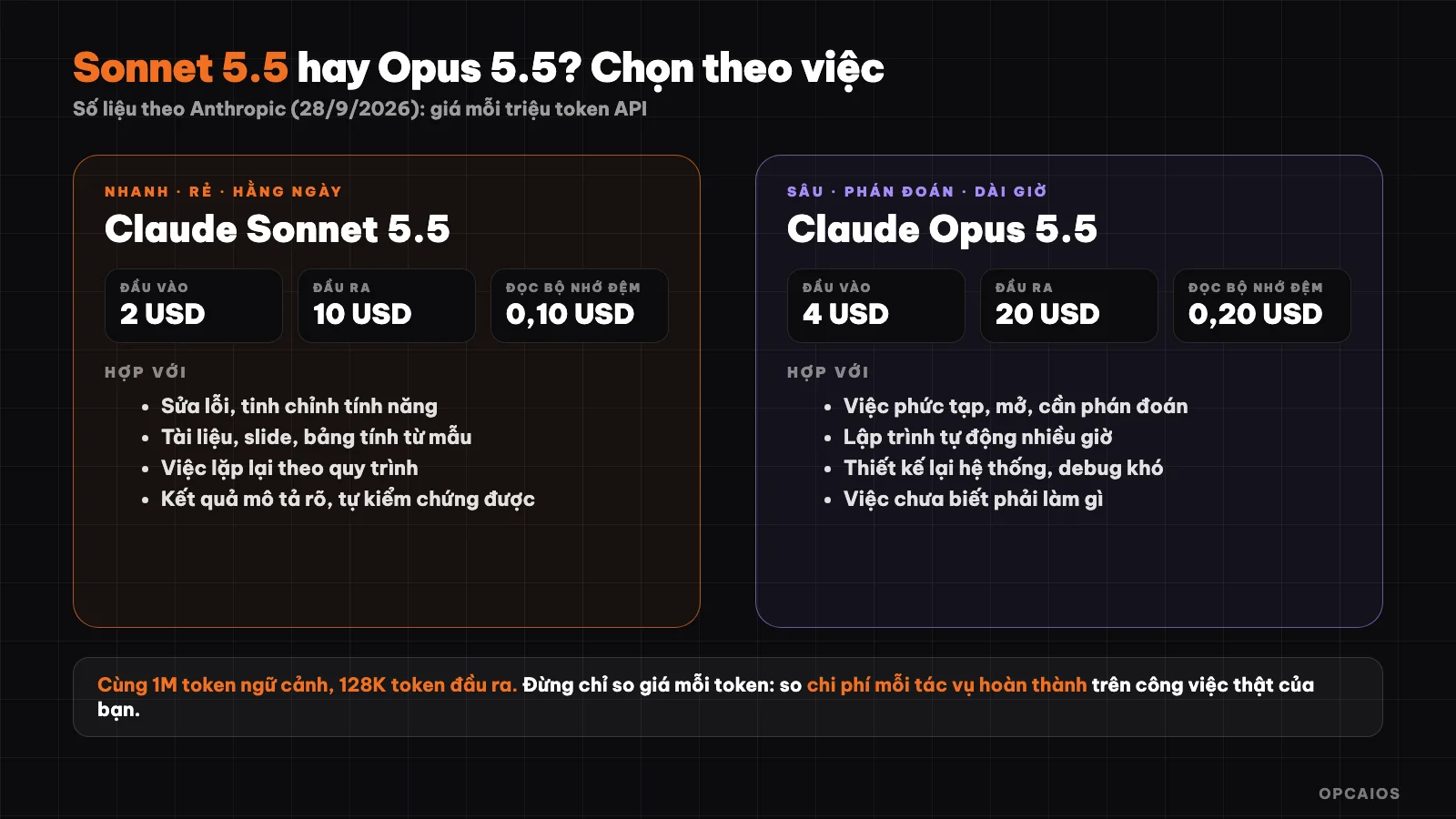
Sonnet 5.5 and Opus 5.5 side by side: API pricing, strengths, and how to choose. Data from Anthropic. Diagram: OPCAIOS.
What's new in Claude Sonnet 5.5?
Sonnet 5.5 is a clear upgrade from Sonnet 5 in four ways, according to Anthropic's official announcement:
- Performance: Terminal-Bench 4.0 score (a command-line agent coding test) rose from 10.3% to 70.6%. On GDPval-AA, a real-world work test across 44 professions, the score is nearly equal to Opus 5.5.
- Collaboration: clearer writing style than the previous generation; early testers described it as a better conversation partner than Sonnet 5.
- Cost: price unchanged from Sonnet 5 but requires far fewer tokens for the same task; cache read price dropped from 0.20 to 0.10 USD per million tokens.
- Speed: output generation 30% faster than Sonnet 5, the fastest Sonnet to date.
This is also the first Sonnet model to launch with cybersecurity safety measures; see more in the final section of this post. Haiku 5.5 for high volume, cost-sensitive work launches a few weeks later.
Sonnet 5.5 benchmarks compared to Opus 5.5 and Sonnet 5
Benchmarks show Sonnet 5.5 approaching Opus 5.5 on many tests, but cannot replace it in every task. The data below comes from Anthropic's table, self-reported by the maker:
| Benchmark | Sonnet 5.5 | Sonnet 5 | Opus 5.5 |
|---|---|---|---|
| Terminal-Bench 4.0 (agent coding) | 70.6% | 10.3% | 66.4% |
| CursorBench 4.0 (real-world programming work) | 55.5% | 34.1% | 57.8% |
| GDPval-AA (44 professions, Elo score) | 1,844 | 1,449 | 1,846 |
| OSWorld 2.1 (computer control) | 80.1% | 57.0% | 81.8% |
| Humanity's Last Exam (with tools) | 64.5% | 54.9% | 67.7% |
| Chartography (chart reading) | 61.6% | 15.6% | 64.4% |
Two notes. First, Terminal-Bench for Sonnet 5.5 is higher than Opus 5.5, but a single benchmark score does not mean the two models are equal. Second, Anthropic itself writes that by their tests and outside tests, Opus 5.5 remains clearly stronger at complex, open-ended work requiring ongoing judgment. Scores are only one angle; try it on your own work, as explained in the guide Which AI model should you choose?.
How much does Claude Sonnet 5.5 cost compared to Opus 5.5?
API pricing is charged per million tokens that developers pay to Anthropic, and Sonnet 5.5 costs half of Opus 5.5 for both input and output. According to Anthropic's pricing page (checked on 22/10/2026), Sonnet 5.5 is $2 input and $10 output, while Opus 5.5 is $4 and $20. Batch processing reduces Sonnet 5.5 to $1 and $5. Here's the detailed pricing table per million tokens:
| Type | Sonnet 5.5 | Opus 5.5 |
|---|---|---|
| Input tokens | $2 | $4 |
| Output tokens | $10 | $20 |
| Cache reads | $0.10 | $0.20 |
| Cache writes (5 min) | $2.50 | $5 |
| Batch processing (input / output) | $1 / $5 | $2 / $10 |
Example calculation (illustrative numbers, ignoring cache): a task using 100,000 input tokens and 20,000 output tokens costs around $0.40 with Sonnet 5.5 (0.1 million × 2 + 0.02 million × 10) and around $0.80 with Opus 5.5 if both models use the same token counts. In reality, each model uses different token amounts, so comparisons should be based on cost per completed task, not just price per token.
Other specs from the official model page: 1 million token context window, 128,000 token max output, training data reliable through June 2026, model code claude-sonnet-5-5. The model is available on Claude Platform, Amazon Bedrock, Google Cloud, and Microsoft Foundry.
When should I choose Sonnet 5.5, and when should I choose Opus 5.5?
The selection rule is: Sonnet 5.5 works when you have a clear scope and results that can self-verify, while Opus 5.5 works when things are unclear, require deep judgment, and run automatically for long periods. For example, fixing a bug in one file should go to Sonnet 5.5, while redesigning a system over many months should go to Opus 5.5. Based on Anthropic's description:
Right for Sonnet 5.5:
- Daily programming with clear scope: bug fixes, feature refinement.
- Large development volume needing speed and low cost.
- Creating documents, slides, spreadsheets from existing templates.
- Work following fixed procedures.
Right for Opus 5.5:
- Complex work requiring careful judgment.
- Automated programming running many hours.
- Large system redesigns, difficult debugging.
One point worth balancing: Anthropic's model page recommends starting with Opus 5.5 for most workloads if you're unsure, and only upgrading to a higher model when your evaluation falls short. A practical decision approach: start with Sonnet 5.5 for work where you can describe the end result and self-check it; assign Opus 5.5 to work where you're not yet sure what to do. A post from @claudecode84 also notes that in some work like spreadsheets and investor documents, testing shows Opus 5.5 completes faster and cheaper with equivalent quality, so real-world measurement is needed.
What is effort level and which should I choose?
Effort is a setting that tells AI how deeply to think and work: low level answers quickly and uses fewer tokens, high level reasons longer and checks more carefully. According to Anthropic, the default in Claude app and Claude Code is Medium, while on Claude Platform (API) the default is High.
Anthropic reports that on some benchmarks, Sonnet 5.5 at Low or Medium exceeds the highest score of Sonnet 5 at roughly one-tenth the cost per task. Practical guidance (from @claudecode84's synthesis of official documentation): fast chat use Low or Medium; programming with clear instructions use Medium; difficult or long work use High; higher levels for very long automated tasks; Max level shouldn't be used routinely. The post also cites third-party results showing that at Max level, Sonnet 5.5 uses very many tokens and may cost more than Sonnet 5 at Max by about 50%; this result hasn't been verified by OPCAIOS, but it shows why you shouldn't set the level higher than necessary.
How to Use Sonnet 5.5 in Claude Code
In Claude Code, I choose the model myself using the /model command or a startup flag. According to @claudecode84's post, two common ways are:
/model sonnet
claude --model claude-sonnet-5-5
That same post describes the /model opusplan mode: the planning stage uses Opus 5.5, the coding stage uses Sonnet 5.5, meaning "design with Opus, execute with Sonnet" all in one setup. The mode and command name may change between versions, so I should check the current Claude Code documentation. I also need to measure in practice: setting up Opus to plan then handing Sonnet the work is not always cheaper than using Opus alone.
A few habits that users report (not manufacturer commitments): asking clearly "run tests, check types and build then show me the results" instead of trusting a "done" claim; at low effort levels the model may pause midway to ask, so I should state when stopping is allowed. About AI writing code for the wrong library version, see the post AI writing code with wrong version.
How to write requests for Sonnet 5.5 to keep them stable?
A stable request for Sonnet 5.5 has four parts: the task to do, information needed, what not to do, and what counts as done. This approach is more stable than listing dozens of detailed steps, since I describe the goal and completion condition then let Claude choose how. For example, suppose: "fix the login bug in auth.ts, don't change the interface, done when the login test passes in one run" is shorter than 20 instructions but clearer on the goal. According to @claudecode84's post on X, the tips below help reduce mistakes.
Some concrete tips from @claudecode84's post:
- When I only want an idea: add the line "give me the options then stop, don't create files", because broad requests sometimes make AI build a whole slideshow on its own.
- When asking for information or changes like price or terms: ask to verify by searching first before answering.
- When making a slideshow: give the company template first so AI follows the layout, fonts, colors.
- When making a spreadsheet: ask to "use formulas", then change a few inputs to see if results auto-update.
- When switching models midway: better to start a new conversation, since switching midway loses the context already thought through and the buffer has to rebuild.
Safety notes and limits of Sonnet 5.5
Sonnet 5.5 has two things I should know before using. On safety, because the model's cybersecurity ability has grown stronger, Anthropic deploys with measures like Opus 5.5: I still find and fix bugs in code normally, but high-risk cybersecurity tasks will clearly switch to answering with Sonnet 5, and there is a notice when switching. For biology, the measure is like Sonnet 5; some legitimate requests about microbiology or virology may be flagged by mistake.
On limits, according to Anthropic itself, Opus 5.5 is still stronger on open and complex tasks. @claudecode84's post adds some third-party comments, not verified: Sonnet 5.5 may be weaker than Opus 5.5 on knowledge tests (54% versus 66%), sometimes fills in expected values from memory in test cases, or is less precise on design details. Common way to cut risk: let the machine verify results and keep a reviewer at the final step.
Frequently Asked Questions
When did Claude Sonnet 5.5 launch and what is its price?
Sonnet 5.5 launched on September 28, 2026. The API price is 2 USD per million input tokens and 10 USD per million output tokens, exactly the same as Sonnet 5 and half the price of Opus 5.5.
Is Sonnet 5.5 as good as Opus 5.5?
It's nearly on par on many tests like agent code writing and 44-profession work, but Anthropic says Opus 5.5 is still noticeably stronger on complex tasks that are open-ended and require long-term judgment. Try it on your actual work.
Should I use Sonnet 5.5 or Opus 5.5 for programming?
Use Sonnet 5.5 for daily programming with clear scope like bug fixes and feature refinement; use Opus 5.5 for automation that runs many hours, system redesign, or hard debugging. You can mix them: Opus for planning, Sonnet for execution.
Can I use Sonnet 5.5 for free?
According to Anthropic, anyone can chat with Sonnet 5.5 on Claude.ai (web, iOS, Android). Usage limits for each plan may change—check Anthropic's plan page. Using through the API is billed per token.
What is the API model code for Sonnet 5.5?
The API model code is the identifier string used to call the correct model in your code. For Sonnet 5.5, the code is claude-sonnet-5-5 on Claude API; on Amazon Bedrock it's anthropic.claude-sonnet-5-5; on Google Cloud and Microsoft Foundry it's claude-sonnet-5-5. The $2 and $10 per million tokens are prices on Anthropic's pricing page; prices on other platforms haven't been checked by OPCAIOS so see each platform's pricing page. To connect your system through the API, see the post What is API? and information about Claude.
Sources: Claude Sonnet 5.5 announcement (September 28, 2026), Anthropic's models and pricing pages (checked October 22, 2026); usage tips from the post by @claudecode84 on X (September 30, 2026), third-party comments not yet verified by OPCAIOS. Prices and limits may change.
Translated from Vietnamese with AI. Read the original.
Want to apply this in your business?
Book a free 30-minute call (Vietnam time, in English or Vietnamese).