


n8n is a workflow automation platform that lets you connect applications and services using drag-and-drop diagrams, with the ability to write code when needed. n8n runs on your own server or the company's cloud service, and now supports AI agents. For small business owners, n8n replaces repetitive work like copying data from forms into spreadsheets, alerting when new orders arrive, or summarizing emails, with a self-running process.
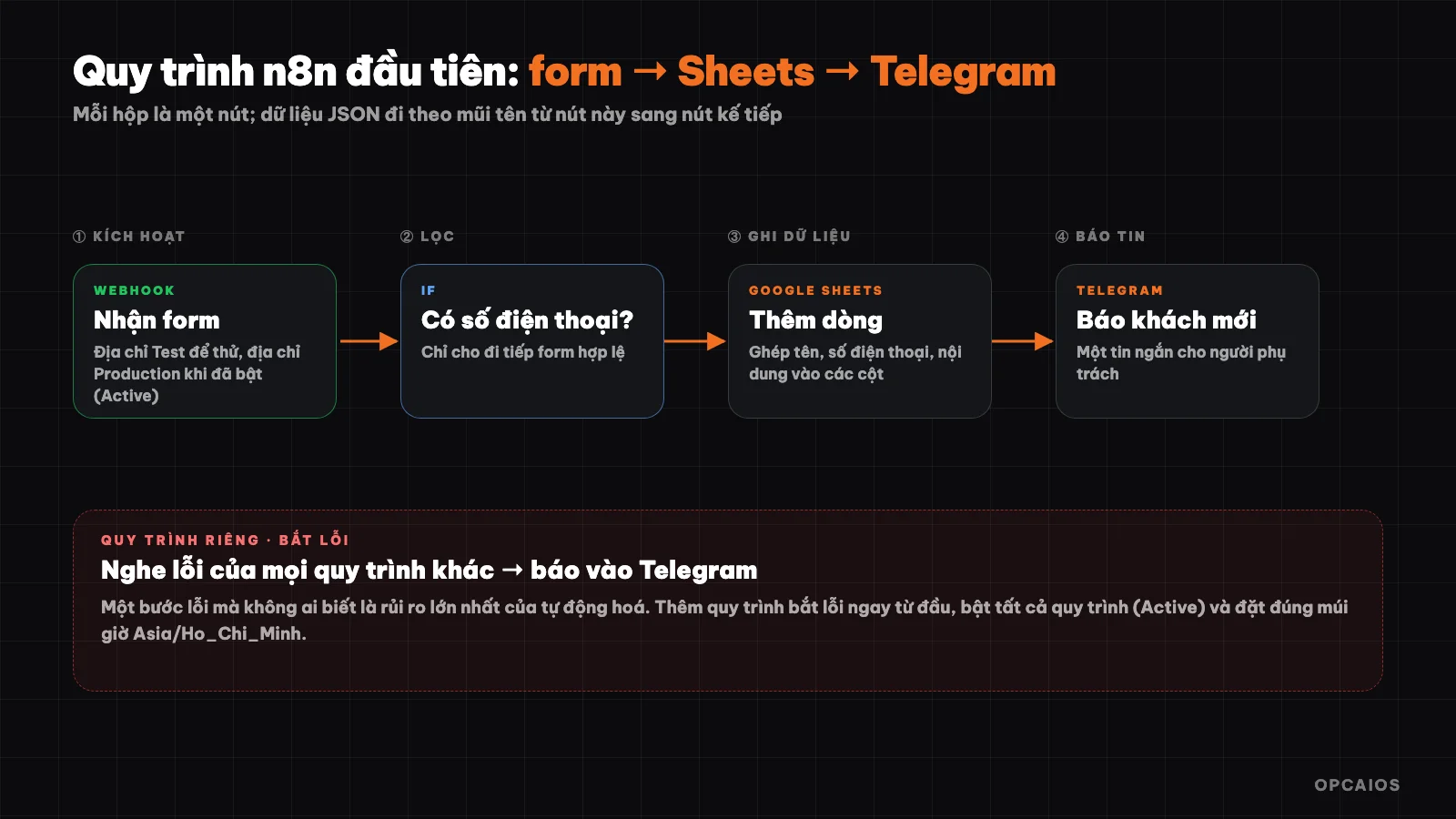
A typical n8n workflow: triggering event, then processing steps connected in sequence. Diagram: OPCAIOS.
What is n8n?
n8n is a workflow automation and AI agent building platform under the "fair-code" model: open source code, self-deployable, but released under the Sustainable Use License rather than a purely open-source license. According to the official README, n8n combines a drag-and-drop interface with JavaScript or Python code when needed, connects over 1,500 services, and has over 9,000 pre-built workflow templates. For example, one template workflow can connect Gmail to Google Sheets and Slack with just a few drag-and-drop actions.
The name "n8n" is read as "n-eight-n", short for "nodemation": "node" because the interface uses nodes connected together and runs on Node.js, "mation" from "automation". According to GitHub in October 2026, the project has over 208,000 stars and is continuously updated.
Three features make n8n different from many similar tools:
- Self-deployable: you run n8n on your own server, so your data never leaves the infrastructure you manage.
- Code as fallback: when you hit something difficult, you insert a code node instead of being blocked by the interface.
- AI support: has built-in AI agent nodes, can connect to models from OpenAI, Anthropic, Google, or open-source models, and switch providers without rebuilding your workflow.
How does n8n work?
A workflow in n8n is a sequence of nodes connected by arrows: the first node is a trigger, and the following nodes process data in order. Example scenario: when someone fills out a form, a Webhook node receives the data, an IF node filters it, a Google Sheets node adds a row, and a Telegram node sends an alert within seconds. Data flows through each node as a list of JSON items, and each following node can read every field created by the previous node.
| Node type | Role | Example |
|---|---|---|
| Trigger | Start the workflow | Webhook receives data, schedule runs by time, new message |
| Action | Do something with an application | Add row to Google Sheets, send Telegram message |
| Logic | Branch, merge, filter | IF, Switch, Merge |
| External call | Call any API | HTTP Request |
| Code | Custom processing with JavaScript or Python | Code |
| AI | Use AI models, agents | AI Agent |
If you're not yet familiar with the two foundational concepts, read first What is an API? and What is a webhook?: almost every n8n workflow starts with a webhook and uses API call nodes to do work.
How is n8n different from Make and Zapier?
n8n differs from Make and Zapier mainly in where it runs, how it charges, and your level of technical freedom, though all three connect applications and auto-run workflows. According to the official README, n8n connects over 1,500 services; Zapier connects over 9,000 applications according to Zapier's homepage. Example scenario: a business running 10,000 executions per month needs to compare n8n's server costs with Zapier's per-task fees.
| Criterion | n8n | Make and Zapier |
|---|---|---|
| Where it runs | Self-hosted on your own server or use n8n's cloud | Cloud service |
| How it charges | Self-hosted: cost is your server; cloud: by plan | By plan and number of operations |
| Writing code | Has code node, can use npm libraries | More limited |
| Data | Can stay entirely on your infrastructure | Goes through provider's infrastructure |
| Ease for beginners | Requires getting familiar with concepts a bit more | Easier to start |
Choose Make or Zapier if you want to run something in 15 minutes and don't want to manage a server. Choose n8n if you need data control, have large volumes, or need to embed code and AI into your workflow. Details on each tool are in the library: n8n, Make, Zapier.
How do I install n8n?
Installing n8n means running a Docker container on your machine or on a server. According to the official n8n README on GitHub, there are two ways. For example, a beginner just needs Docker Desktop on their personal machine and about 10 minutes to see the editor. The fastest way is to use the installation command (you need to install Docker first):
curl -fsSL https://get.n8n.io | sh
Or run it manually with Docker, using a volume so your data doesn't get lost when you restart:
docker volume create n8n_data
docker run -it --rm --name n8n -p 5678:5678 -v n8n_data:/home/node/.n8n docker.n8n.io/n8nio/n8n
Then open the editor at http://localhost:5678. Running on your personal machine is enough for learning. If you want a workflow to run 24/7 and receive webhooks from the Internet, you need a separate server (VPS) with a public IP address and HTTPS. OPCAIOS itself runs n8n on a separate server for internal workflows.
Two things you shouldn't skip when installing yourself: backing up the data volume and encrypting the login credentials (the environment variable N8N_ENCRYPTION_KEY), because losing the key means any connected accounts can't be read again; and don't leave the editor open publicly without authentication.
How do I create my first n8n workflow?
The first workflow should be simple and immediately useful: when someone fills out a contact form on your website, save it to Google Sheets and send a notification to Telegram. Follow these steps:
- Create a new workflow and add a Webhook node as the trigger. n8n gives you two addresses: a Test address and a Production address.
- Paste the Test address into the webhook section of your website or form, and send a test form so n8n receives sample data.
- Add an IF node to filter, for example only process forms that have a phone number.
- Add a Google Sheets node (add row) and map the fields from the form to the columns.
- Add a Telegram node to send a notification about the new contact.
- Turn on the workflow (Active) then switch your website to the Production address.
The website opcaios.org can send a webhook when there's a new form submission, with a signature so the receiver can authenticate it; the post What is a Webhook? explains how to verify the signature, and n8n can do this with a Crypto node combined with an IF node.
Common mistakes when using n8n
Common mistakes when using n8n are repeated errors that beginners make, grouped into 5 categories below, and most are easy to fix if you know about them beforehand. For example, a workflow scheduled for 8 AM runs at 1 AM just because you set the timezone wrong.
- Confusing Test and Production addresses. The Test address only works while you're listening in the editor; the Production address only receives data when the workflow is turned on. Sending to the Production address when the workflow is off will get a 404 error. We've seen this exact situation: a webhook used to connect internal agents returned 404 because the corresponding workflow hadn't been imported and turned on on the server.
- Forgetting to turn on the workflow. A workflow that's saved but not Active won't run on schedule by itself.
- Wrong timezone. The schedule node runs on n8n's timezone; set it correctly (for example Asia/Ho_Chi_Minh) so an 8 AM workflow doesn't run at 1 AM.
- Misunderstanding multi-item data. A node that receives a list means the next nodes run once for each item; if you only want to run once, you need to merge first.
- Not handling errors. When a step fails, the workflow stops silently. Add a separate workflow that listens for errors and notifies Telegram or email so you know right away.
What security things should I watch out for when installing n8n myself?
Security when installing n8n yourself means protecting the keys and passwords of many services like Google, OpenAI, or Telegram that n8n stores, so an n8n server is a worthwhile target and needs protection like a small safe. Example scenario: if the editor is open publicly without authentication, a stranger can use the keys of 5 already-connected services. The minimum checklist has five things:
- Run behind HTTPS and restrict access to the editor with strong authentication.
- Update regularly n8n and your server's operating system.
- One key per service, minimum permissions: use read-only permissions if the workflow only looks things up.
- Authenticate incoming webhooks with a key or signature, so no one can fake events.
- Back up regularly your data and encryption key, and test recovery.
When to use n8n, when not to?
You should use n8n when the process repeats many times, involves 2 or more applications, and the rules are clear enough to write out as steps. For example: a task that takes 3 hours a week like pushing contacts from a form into a CRM, compiling weekly reports, sending appointment reminders, or sorting emails with AI.
You should not use it when the job only happens a few times, when the rules are still unclear and need judgment call by call, or when you don't have anyone to maintain the server. In those cases, cloud services like Make or Zapier, or doing it by hand, are less hassle.
With AI agents, the README describes n8n supporting multi-step processes, using tools, and having a human review step. You should keep the human review step before actions that can't be undone, like sending bulk emails or changing customer data; see more in the post What is graph engineering? about designing AI workflows with independent verification steps. If you need AI to call into your systems, the post What is MCP? explains the connection standard.
Read more: Guide to installing n8n on VPS and automating business processes from A-Z for Solopreneurs; Automatic weekly reports for OPC owners; How to automatically track prices and posts from competitors using Firecrawl and n8n.
Frequently asked questions
Is n8n free?
Self-hosting n8n on your own server costs no license fees under the Sustainable Use license for internal use, but you pay for the server and maintenance work. n8n's cloud version charges by plan. Read the license carefully on the official site if you plan to sell n8n as a service to customers.
Is n8n open source?
Not entirely. n8n is "fair-code": source code is public and self-hostable, but the Sustainable Use license restricts how you can commercialize it, unlike pure open source licenses like MIT.
Do you need to know programming to use n8n?
Not required for basic workflows: drag and drop nodes and map fields. Knowing JSON and understanding APIs helps a lot when workflows get more complex, and the Code node lets you use JavaScript or Python when needed.
Should I use n8n or Make?
Choose Make if you want to get running now without managing a server. Choose n8n if you need data control, high volume, or want to embed code and AI. Many people start with cloud then switch to self-hosting as they scale.
Where should I learn n8n quickly?
Start with a small workflow like the form to Google Sheets example above, use pre-built templates on the official site, and read the docs at docs.n8n.io. If you want to build automation workflows for your business, check out OPCAIOS's AI application training course.
Source: Official README of n8n on GitHub and n8n.io (checked 22/10/2026); OPCAIOS's experience running n8n.
Translated from Vietnamese with AI. Read the original.
Want to apply this in your business?
Book a free 30-minute call (Vietnam time, in English or Vietnamese).