


Zapier is a cloud service that helps applications automatically exchange data with each other without writing code: when an event happens in one application, Zapier automatically performs an action in another application. Each process is called a Zap, consisting of a trigger event and one or more actions. According to their website, Zapier connects over 9,000 applications and has a free plan of 100 tasks per month, making it the easiest way to try automation if you don't have technical staff. A hypothetical example: a store owner could create a Zap that copies 200 form responses each month into Google Sheets and notifies Slack without writing a single line of code. According to Zapier's official pricing page (checked on 22/10/2026), the Professional plan starts at $19.99 per month when billed annually. This article explains Zaps, tasks, how to create your first Zap, and compares it with Make and n8n.
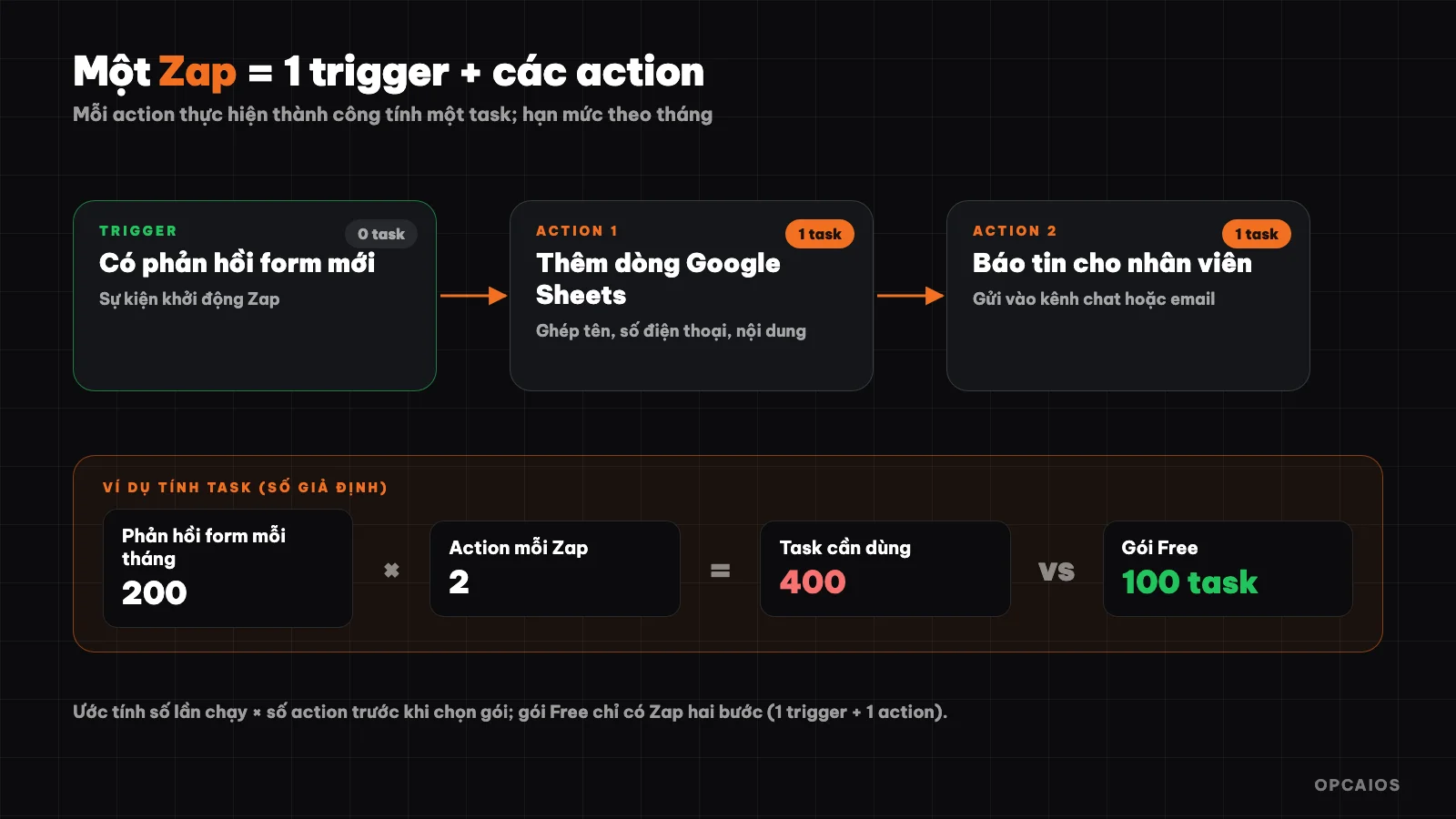
A basic Zap: one trigger and connected actions. Diagram: OPCAIOS.
What is Zapier?
Zapier is a no-code automation platform that runs entirely on the cloud, connecting popular applications like Gmail, Google Sheets, Slack, HubSpot, Salesforce, and thousands of other apps. Users don't install anything on a server: sign up for an account, choose applications, select an event, and Zapier runs the workflow for you. Beyond Zaps, their official website now introduces Tables (storing data for Zaps to read and update), Forms (forms that trigger workflows), Agents (AI assistants that work on tools), Chatbots, and Zapier MCP so AI assistants like Claude from Anthropic or ChatGPT from OpenAI can use Zapier's connections. Large enterprises get additional permissions, activity logs, and security certifications like SOC 2 Type II. A hypothetical example: when a customer fills out a form, Zapier can automatically add a row to Google Sheets the next time the trigger checks.
How does a Zap work?
A Zap is a sequence consisting of exactly one trigger and one or more actions, running in order from top to bottom. Three concepts to understand:
| Concept | Meaning | Example |
|---|---|---|
| Trigger | The event that starts a Zap | New form response, new email, new row in spreadsheet |
| Action | What the Zap does afterward | Add row to Google Sheets, send Slack message, create contact in CRM |
| Task | Unit of measurement for quota | Each successful action the Zap performs counts as one task |
Data from the trigger gets "mapped" to the actions: you drag the "customer name" field from the form into the "name" cell of the CRM. Besides trigger and action, a Zap can have supporting steps like filters, data formatting (formatter), and conditional branching (Paths).
Zapier also receives webhooks through a dedicated trigger, so systems that send events like websites can connect too. If you're not familiar with this concept, read the articles What is a Webhook? and What is an API?.
Is Zapier free and what is a task?
Zapier has a permanent free plan: according to Zapier's official pricing page (checked on 22/10/2026), the Free plan includes unlimited Zaps, Tables, and Forms but only 100 tasks per month and can only use two-step Zaps (one trigger and one action). The paid Professional plan starts at $19.99 per month when billed annually, enabling multi-step Zaps and Paths (conditional branching). Pricing and limits may change, so check the current pricing page before deciding.
Task is the unit of measurement for quota: each successful action performed by a Zap counts as one task. The quota is monthly, so the more times a Zap runs and the more actions it has, the more tasks it consumes.
Example calculation (hypothetical numbers, for illustration): a form receives 200 responses each month, the Zap has two actions: add a row to Google Sheets and send a notification message. Each response uses 2 tasks, totaling 400 tasks per month, four times the Free plan's 100 tasks, so you need to consider a paid plan from $19.99 per month. Therefore, don't just look at the monthly price; estimate the number of runs multiplied by the number of actions before choosing a plan. According to Zapier's documentation, some supporting steps like filters don't count toward task quota, so filtering data early that you don't need helps save quota.
How to create your first Zap?
Creating your first Zap is a six-step process that's the same across all apps. The most common example is: when someone fills out a contact form, save it to Google Sheets and notify staff via Slack or Gmail. First you choose a trigger, then add an action, and finally test and turn on the Zap.
- Create a Zapier account (the Free plan is enough to try).
- Choose a trigger: the form app you use and the "new response" event.
- Add an action: Google Sheets, the "add row" action.
- Map fields: drag the name, phone number, message from the form into the corresponding columns.
- Test each step with sample data. Note that test data may differ from real data.
- Turn on the Zap. The Zap only processes data created after you turn it on.
With the Free plan, adding a notification step requires upgrading because a Zap only has two steps. A cost-saving approach: have one app handle both tasks, for example the spreadsheet automatically sends a notification when a new row is added.
How is Zapier different from Make and n8n?
Zapier differs from Make and n8n in ease of use, where it runs, and how it charges, though all three connect apps through self-running workflows. Zapier runs on the cloud, has over 9,000 apps, and charges by task, while n8n has over 1,500 apps according to its README and can be installed on your own server. For example: if a business runs 10,000 executions monthly, compare the per-task cost with n8n's server cost before choosing.
| Criteria | Zapier | Make | n8n |
|---|---|---|---|
| Where it runs | Zapier's cloud | Cloud | Self-hosted or cloud |
| Ease for beginners | Easiest, step-by-step interface | Intuitive, requires more practice | Requires more conceptual understanding |
| Number of apps available | Over 9,000 | Many | Over 1,500 (per README) |
| Pricing model | Per task | Per plan and operation volume | Self-hosted: server cost |
| Code writing, technical freedom | Limited | Moderate | High |
Choose Zapier if you want to get running in minutes, have minimal technical staff, and use many popular apps. Choose n8n if you need data control or handle large volumes; see the post What is n8n?. Summary information for each tool is in the library: Zapier, Make, n8n.
Who is Zapier right and wrong for?
Zapier is right for you when you want to automate repetitive tasks between familiar apps with minimal technical work, and your volume is moderate. First, typical uses for small businesses:
- Collect leads from forms into your CRM and notify the person in charge.
- Log new orders into a spreadsheet to track them.
- Send notifications to chat channels when there's an order, review, or support request.
- Add an AI step to summarize or categorize requests and route to the right person.
Next are cases where Zapier is less suitable. Zapier is less suitable when: your volume is high and per-task costs rise quickly; you want sensitive data to stay entirely on your own infrastructure (because workflows run on the provider's cloud); or your process needs complex code handling. The Free plan also has latency: according to the pricing page, Zapier checks for new trigger data about every 15 minutes on the Free plan, 2 minutes on Professional, and 1 minute on higher plans, so it's not for work needing immediate response.
How does Zapier connect to your website?
Webhook is the most flexible way to connect your website to Zapier: your website sends an event to Zapier as soon as it happens, rather than waiting for Zapier to ask periodically (the Free plan only checks about every 15 minutes). For example, opcaios.org can send a webhook when there's a new form submission or a paid order, with a signature so the receiver can verify it; details in the post What is a webhook?. Zapier receives webhooks with its own trigger, and to verify the signature you need to add a processing step.
If you need Zapier to actively fetch data, use an API: your website has a REST API to fetch lists of posts, customers, and orders, using API keys with read-only or read-and-write permissions. If you want an AI assistant to use Zapier's connections, read the post What is MCP?.
Tips for Using Zapier Effectively and Saving Tasks
A few habits help Zaps run smoothly and not waste tasks needlessly:
- Start with a two-step Zap for one simple repetitive task, then expand later.
- Name your Zap by business process, for example "Contact form → Sheets → send alert", so it's easy to manage when you have dozens of Zaps.
- Filter early: place a filter right after the trigger so unnecessary data stops there and doesn't consume tasks.
- Track task usage weekly in the first few months to know which plan is enough for you.
- Test with real data after turning it on, since sample data can differ from actual data.
- Set up error alerts: when a Zap fails, you need to be notified right away instead of discovering it days later.
Frequently Asked Questions
Is Zapier free?
There's a Free plan with 100 tasks per month, two-step Zaps, and unlimited Zaps, Tables, and Forms. The Professional plan starts at 19.99 USD per month when paid annually. Pricing changes over time, check the official pricing page for current rates.
What is a task in Zapier?
A task is the unit of measurement for your quota, corresponding to successful Zap actions. The more times a Zap runs and the more actions it performs, the more tasks you use in a month.
Do you need to know programming to use Zapier?
No. Zapier is designed for non-coders: you pick apps, pick events, and connect data fields through the interface. Knowing how to read JSON data helps when working with webhooks or APIs.
Should I use Zapier or n8n?
Choose Zapier if you want the easiest option with minimal technical management. Choose n8n if you need data control, large volumes, or code integration. Many people start with Zapier and move to self-hosted tools as they scale.
Where can I learn Zapier quickly?
Use the pre-made Zap templates on the official site and follow Zapier's "Create Zaps" documentation. If you want to build automation workflows for small business, check out OPCAIOS's AI application training program.
Source: homepage and official pricing page of Zapier (checked 22/10/2026); pricing and limits may change.
Translated from Vietnamese with AI. Read the original.
Want to apply this in your business?
Book a free 30-minute call (Vietnam time, in English or Vietnamese).